Millipore Sigma Vibrant Logo

855012 Trityl chloride resin

855012
View Pricing & Availability

Overview

Replacement Information
Description
Catalogue Number855012
Replaces01-64-0074
Brand Family Novabiochem®
Background InformationAn acid-labile resin for the solid phase immobilization of alcohols [1-5], amines [4, 6-12], sugars [13], O- and N-linked hydroxylamines [14, 15], imidazoles [16] and carboxylic acids [16]. Release of these functionalities is generally achieved using 1-5% TFA in DCM containing 5% TIS. Amines can also be cleaved with 30% HFIP in DCM [4]. This resin, although very acid sensitive, can also be used in peptide synthesis [17].

The product number for this product was previously 01-64-0074.

To obtain a certificate of analysis (CoA) of a lot that begins with the letter "A", please select the option in the right hand menu "Request a COA for Lot#s starting with A".
References
Product Information
HS Code3903 90 90
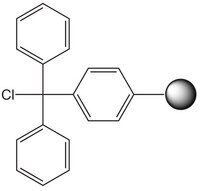
Structure formula ImageStructure formula Image
Quality LevelMQ200
Applications
Biological Information
Physicochemical Information
Dimensions
Materials Information
Toxicological Information
Safety Information according to GHS
Storage class10 - 13 Other liquids and solids
WGKWGK 1 slightly hazardous to water
Safety Information
Product Usage Statements
Storage and Shipping Information
StorageStore below +30°C.
Packaging Information
Transport Information
Supplemental Information
Specifications
Color (visual)white to yellow to beige
Appearance of substance (visual)beads
Loading (determined from the substitution of the Fmoc-Ala-Leu loaded resin)1.1 - 1.7 mmol/g
Swelling Volume (in CH₂Cl₂)lot specific result
The polymer matrix is copoly (styrene-1 % DVB), 200 - 400 mesh

Documentation

Trityl chloride resin SDS

Title

Safety Data Sheet (SDS) 

Citations

Title
  • [1] C. C. Leznoff (1978) Acc. Chem. Res., 11, 327.
  • [2] C. Chen, et al. (1994) J. Am. Chem. Soc., 116, 2661.
  • [3] Z. Li & A. Ganesan (1998) Syn. Lett., 405.
  • [4] P. Athanassopoulos, et al., Poster 316 presented at the 24th European Peptide Symposium, Edinburgh, 1996.
  • [5] K. Barlos, et al. (1988) Liebigs Ann. Chem., 1079.
  • [6] K. Barlos, et al. in 'Peptides 1992, Proc. 22nd European Peptide Symposium', C. H. Schneider & A. N. Eberle (Eds), ESCOM, Leiden, 1993, pp. 281.
  • [7] M. Schuster, et al. (1996) Angew. Chem. Int. Ed. Engl., 35, 1979.
  • [8] P. Garibay, et al. (1998) Tetrahedron Lett., 39, 2207.
  • [9] Y. Guan, et al. (2000) J. Comb. Chem., 2, 297.
  • [10] S. Manku, et al. (2001) J. Org. Chem., 66, 874.
  • [11] D. Jönsson, et al. (2001) Tetrahedron Lett., 42, 6953.
  • [12] C. A. Olsen, et al. (2003) Org. Lett., 5, 4183.
  • [13] F. Peri, et al. (2000) Tetrahedron Lett., 41, 8587.
  • [14] U. Bauer, et al. (1997) Tetrahedron Lett., 38, 7233.
  • [15] O. Kinzel, et al. (2003) J. Peptide Sci., 9, 375.
  • [16] D. P. Matthews, et al. (2000) J Comb. Chem., 2, 19.
  • [17] K. Barlos, et al. (1989) Tetrahedron Lett., 30, 3943.