
CA1023

Anti-Hsp90α Mouse mAb (EMD-17D7)
liquid, clone EMD-17D7, Calbiochem®
別名:
Anti-Heat Shock Protein 90α
ログインで組織・契約価格をご覧ください。
サイズを選択してください
この商品について
NACRES:
NA.41
UNSPSC Code:
12352203
Clone:
EMD-17D7, monoclonal
Species reactivity:
human
Application:
Citations:
12
製品名
Anti-Hsp90α Mouse mAb (EMD-17D7), liquid, clone EMD-17D7, Calbiochem®
biological source
mouse
antibody form
purified antibody
antibody product type
primary antibodies
clone
EMD-17D7, monoclonal
form
liquid
contains
≤0.1% sodium azide as preservative
species reactivity
human
manufacturer/tradename
Calbiochem®
storage condition
OK to freeze
avoid repeated freeze/thaw cycles
dilution
(ELISA
Immunoblotting (1 µg/mL)
Immunoprecipitation (5 µg/0.7 mg protein))
isotype
IgG1
shipped in
wet ice
storage temp.
−20°C
target post-translational modification
unmodified
Quality Level
Analysis Note
Positive Control
H460 and HeLa cells
H460 and HeLa cells
Application
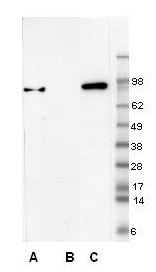
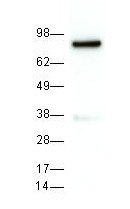
ELISA (see comments)
Immunoblotting (1 g/ml)
Immunoprecipitation (5 g/0.7 mg protein)
Disclaimer
Toxicity: Irritant (B)
General description
Protein G PLUS/protein A purified mouse monoclonal antibody. Recognizes the ~90 kDa Hsp90α protein.
Recognizes the ~90 kDa Hsp90α protein in HeLa cells. Does not recognize Hsp90β.
This Anti-Hsp90α Mouse mAb (EMD-17D7) is validated for use in ELISA, Immunoblotting, Immunoprecipitation for the detection of Hsp90α.
Immunogen
Hsp90α, His•Tag, Human, Recombinant (Cat. No. 385901)
Human
Other Notes
Detects native and recombinant Hsp90α. Does not recognize Hsp90β. This antibody will also work for ELISA, but concentration is assay dependent. Antibody should be titrated for optimal results in individual systems.
Scheibel, T., et al. 1999. Proc. Natl. Acad. Sci. USA96, 1297.
Nemoto, T., et al. 1997 J. Biol. Chem.272, 26179.
Nemoto, T., et al. 1998. Biochem. J.330, 989.
Nemoto, T., et al. 1997 J. Biol. Chem.272, 26179.
Nemoto, T., et al. 1998. Biochem. J.330, 989.
Packaging
Please refer to vial label for lot-specific concentration.
Physical form
In PBS.
Preparation Note
Following initial thaw, aliquot and freeze (-20°C).
Legal Information
CALBIOCHEM is a registered trademark of Merck KGaA, Darmstadt, Germany
適切な製品が見つかりませんか。
製品選択ツール.をお試しください
保管分類
10 - Combustible liquids
wgk
WGK 1
flash_point_f
Not applicable
flash_point_c
Not applicable
試験成績書(COA)
製品のロット番号・バッチ番号を入力して、試験成績書(COA) を検索できます。ロット番号・バッチ番号は、製品ラベルに「Lot」または「Batch」に続いて記載されています。
Hang-Ming Dong et al.
Respiratory research, 18(1), 111-111 (2017-06-01)
The disruption and hyperpermeability of bronchial epithelial barrier are closely related to the pathogenesis of asthma. House dust mite (HDM), one of the most important allergens, could increase the airway epithelial permeability. Heat shock protein (Hsp) 90α is also implicated
Wei Li et al.
The EMBO journal, 26(5), 1221-1233 (2007-02-17)
Hypoxia is a microenvironmental stress in wounded skin, where it supports wound healing by promoting cell motility. The mechanism of the hypoxia action remained speculative. Here, we provide evidence that hypoxia promotes human dermal fibroblast (HDF) migration by inducing secretion
Lin Liu et al.
Cancer science, 114(10), 4020-4031 (2023-08-23)
Lipids are a major component of extracellular vesicles; however, their significance in tumorigenesis and progression has not been well elucidated. As we previously found that lipid profiles drastically changed in breast tumors upon progression, we hypothesized that lipid profiles of
Priyamvada Jayaprakash et al.
Journal of cell science, 128(8), 1475-1480 (2015-03-05)
When tissues are injured and blood vessels clot, the local environment becomes ischemic, meaning that there is a lack of adequate supply of oxygen and glucose delivered to the surrounding cells. The heat shock protein-90 (Hsp90) family proteins protect tissues
Julian D Gillmore et al.
Journal of the American Society of Nephrology : JASN, 20(2), 444-451 (2008-12-17)
Mutations in the fibrinogen A alpha-chain gene are the most common cause of hereditary renal amyloidosis in the United Kingdom. Previous reports of fibrinogen A alpha-chain amyloidosis have been in isolated kindreds, usually in the context of a novel amyloidogenic
ライフサイエンス、有機合成、材料科学、クロマトグラフィー、分析など、あらゆる分野の研究に経験のあるメンバーがおります。.
製品に関するお問い合わせはこちら(テクニカルサービス)