Wenn Sie das Fenster schließen, wird Ihre Konfiguration nicht gespeichert, es sei denn, Sie haben Ihren Artikel in die Bestellung aufgenommen oder zu Ihren Favoriten hinzugefügt.
Klicken Sie auf OK, um das MILLIPLEX® MAP-Tool zu schließen oder auf Abbrechen, um zu Ihrer Auswahl zurückzukehren.
Wählen Sie konfigurierbare Panels & Premixed-Kits - ODER - Kits für die zelluläre Signaltransduktion & MAPmates™
Konfigurieren Sie Ihre MILLIPLEX® MAP-Kits und lassen sich den Preis anzeigen.
Konfigurierbare Panels & Premixed-Kits
Unser breites Angebot enthält Multiplex-Panels, für die Sie die Analyten auswählen können, die am besten für Ihre Anwendung geeignet sind. Unter einem separaten Register können Sie das Premixed-Cytokin-Format oder ein Singleplex-Kit wählen.
Kits für die zelluläre Signaltransduktion & MAPmates™
Wählen Sie gebrauchsfertige Kits zur Erforschung gesamter Signalwege oder Prozesse. Oder konfigurieren Sie Ihre eigenen Kits mit Singleplex MAPmates™.
Die folgenden MAPmates™ sollten nicht zusammen analysiert werden: -MAPmates™, die einen unterschiedlichen Assaypuffer erfordern. -Phosphospezifische und MAPmate™ Gesamtkombinationen wie Gesamt-GSK3β und Gesamt-GSK3β (Ser 9). -PanTyr und locusspezifische MAPmates™, z.B. Phospho-EGF-Rezeptor und Phospho-STAT1 (Tyr701). -Mehr als 1 Phospho-MAPmate™ für ein einziges Target (Akt, STAT3). -GAPDH und β-Tubulin können nicht mit Kits oder MAPmates™, die panTyr enthalten, analysiert werden.
.
Bestellnummer
Bestellinformationen
St./Pkg.
Liste
Dieser Artikel wurde zu Ihren Favoriten hinzugefügt.
Wählen Sie bitte Spezies, Panelart, Kit oder Probenart
Um Ihr MILLIPLEX® MAP-Kit zu konfigurieren, wählen Sie zunächst eine Spezies, eine Panelart und/oder ein Kit.
Custom Premix Selecting "Custom Premix" option means that all of the beads you have chosen will be premixed in manufacturing before the kit is sent to you.
Catalogue Number
Ordering Description
Qty/Pack
List
Dieser Artikel wurde zu Ihren Favoriten hinzugefügt.
Spezies
Panelart
Gewähltes Kit
Menge
Bestellnummer
Bestellinformationen
St./Pkg.
Listenpreis
96-Well Plate
Menge
Bestellnummer
Bestellinformationen
St./Pkg.
Listenpreis
Weitere Reagenzien hinzufügen (MAPmates erfordern die Verwendung eines Puffer- und Detektionskits)
Menge
Bestellnummer
Bestellinformationen
St./Pkg.
Listenpreis
48-602MAG
Buffer Detection Kit for Magnetic Beads
1 Kit
Platzsparende Option Kunden, die mehrere Kits kaufen, können ihre Multiplex-Assaykomponenten in Kunststoffbeuteln anstelle von Packungen erhalten, um eine kompaktere Lagerung zu ermöglichen.
Dieser Artikel wurde zu Ihren Favoriten hinzugefügt.
Das Produkt wurde in Ihre Bestellung aufgenommen
Sie können nun ein weiteres Kit konfigurieren, ein Premixed-Kit wählen, zur Kasse gehen oder das Bestell-Tool schließen.
ABN1446
Sigma-AldrichAnti-GPRIN1
Anti-GPRIN1 Antibody, Cat. No. ABN1446, is a highly specific rabbit polyclonal antibody that targets GPRIN1 and has been tested in Immunohistochemistry and Western Blotting.
More>>Anti-GPRIN1 Antibody, Cat. No. ABN1446, is a highly specific rabbit polyclonal antibody that targets GPRIN1 and has been tested in Immunohistochemistry and Western Blotting. Less<<
Research Category:
Neuroscience
Gene Symbol:
GPRIN1, KIAA1893
UniProt Number:
Q7Z2K8
G protein-regulated inducer of neurite outgrowth 1
GRIN1
Background Information
G protein-regulated inducer of neurite outgrowth 1 (UniProt Q7Z2K8; also known as GRIN1) is encoded by the GPRIN1 (also known as KIAA1893) gene (Gene ID 114787) in human. Originally identified as a binding protein for guanosine 5'-3-O-(thio)triphosphate-bound G(z)alphaz, G protein-regulated inducer of neurite outgrowth 1 (GPRIN1) is a signaling molecule that functions as a downstream target of G(o)alpha. When co-expressed with constitutively active form of G(o)alpha, GPRIN1 is demonstrated to stimulate neurite extensions in Neuro2a cells. Gprin1 expression in mice is limited to the nervous system at all developmental stages, occurring within the entire embryonic mantle zones and becoming restricted to sets of nuclei at postnatal to adult stages. Gprin1 immunoreactivity is found colocalized with G(o)alpha at neuronal dendrites and axons, while being undetected in glial cells. Studies conducted in rat reveals that 7 nicotinic receptor ( 7) significantly reduces axon growth in hippocampal neurons by coupling to Gprin1, which targets it to the growth cone. RNAi-mediated Gprin1 knockdown abolishes the localization and calcium signaling of 7 at the growth cone. The 7/Gprin1 interaction appears intimately linked to a G(o)alpha, growth-associated protein 43, and CDC42 cytoskeletal regulatory pathway within the developing axon.
References
Product Information
Format
Affinity Purified
Presentation
Purified rabbit polyclonal antibody in buffer containing 0.1 M Tris-Glycine (pH 7.4), 150 mM NaCl with 0.05% sodium azide.
Anti-GPRIN1 Antibody, Cat. No. ABN1446, is a highly specific rabbit polyclonal antibody that targets GPRIN1 and has been tested in Immunohistochemistry and Western Blotting.
Key Applications
Western Blotting
Immunohistochemistry
Application Notes
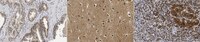
Immunohistochemistry Analysis: A 1:1,000 dilution from a representative lot detected GPRIN1 in human prostate cancer, cerebral cortex and pancreas tissue sections.
Biological Information
Immunogen
KLH-conjugated linear peptide corresponding to an internal sequence of human GPRIN1.
Concentration
Please refer to lot specific datasheet.
Host
Rabbit
Specificity
This rabbit polyclonal antibody targets an internal sequence present in both spliced isoforms of human GPRIN1 protein reported by UniProt (Q7Z2K8).
~105 kDa observed. 102.4 kDa (isoform 1) and 80.95 kDa (isoform 2) calculated. Uncharacterized bands may be observed in some lysate(s).
Physicochemical Information
Dimensions
Materials Information
Toxicological Information
Safety Information according to GHS
Safety Information
Product Usage Statements
Quality Assurance
Evaluated by Western Blotting in HT-29 cell lysate.
Western Blotting Analysis: A 1:20,000 dilution of this antibody detected GPRIN1 in 10 µg of HT-29 cell lysate.
Usage Statement
Unless otherwise stated in our catalog or other company documentation accompanying the product(s), our products are intended for research use only and are not to be used for any other purpose, which includes but is not limited to, unauthorized commercial uses, in vitro diagnostic uses, ex vivo or in vivo therapeutic uses or any type of consumption or application to humans or animals.