Millipore Sigma Vibrant Logo

IM57 Anti-MT1-MMP (Ab-4) Mouse mAb (113-5B7)
Übersicht

Replacement Information

Key Spec Table

Species ReactivityHostAntibody Type
H, M, Rb, RMMonoclonal Antibody

Preis & Verfügbarkeit

Bestellnummer VerfügbarkeitVerpackung St./Pkg. Preis Menge
IM57-100UG
Verfügbarkeit wird abgerufen...
Eingeschränkte Verfügbarkeit
Lieferbar 
Produkt wurde eingestellt
Begrenzter Lagerbestand
Bestätigung der Verfügbarkeit erforderlich
    Restmenge: Angebot folgt
      Restmenge: Angebot folgt
      Bitte erfragen
      Kontakt zum Kundenservice
      Contact Customer Service

      Kst.-Ampulle 100 μg
      Preis wird abgerufen...
      Preis nicht abrufbar
      Die Mindestmenge muss ein Vielfaches sein von
      Maximum Quantity is
      Bei Bestätigung Weitere Informationen
      Sie haben () gespart
       
      Bitte erfragen
      Description
      OverviewRecognizes the ~60 kDa MTI-MMP protein in HT-1080 cells and in ConA-treated MD-MB-231 cells.
      Catalogue NumberIM57
      Brand Family Calbiochem®
      Application Data
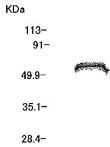
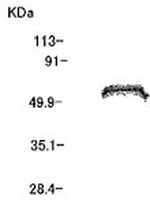
      Detection of hamster MT1-MMP by immunoblotting. Sample: Expressed in CHO cells. Primary antibody: Anti-MT1-MMP (Ab-4) Mouse mAb (113-5B7) (Cat. No. IM57) (10 µg/ml). Detection: chemiluminescence.
      References
      ReferencesSakakibara, M., et al. 1999. Cancer 85, 231-239.
      Mattei, M.G., et al. 1997. Genomics: 40, 168.
      Okada, A., et al. 1997. J. Cell. Biol. 147, 67.
      Okumura, Y., et al. 1997. FEBS Lett. 402, 181.
      Ueno, H., et al. 1997. Cancer Res. 57, 2055.
      Strongin, A.Y., et al. 1995. J. Biol. Chem. 270 5331.
      Takino, T., et al. 1995. J. Biol. Chem. 270, 23013.
      Cottam, D. W. and Rees, R. C., 1993. Intl J. Oncol. 2, 861.
      Stetler-Stevenson, W. G., et al. 1993. FASEB J. 7, 1434.
      Fridman, R., et al. 1992. J. Biol. Chem. 267, 15389.
      Woessner, J. F., 1991. FASEB J. 5, 2145.
      Liotta, L. A. and Stetler-Stevenson, W. G., 1990. in Sem. Cancer Biol., ed. M. M. Gottesman. Vol. 1(2), 99.
      Goldberg, G.I., et al. 1989. PNAS 86, 8207.
      Product Information
      DeclarationManufactured by Daiichi Fine Chemicals C0., Ltd., Not available for sale in Japan.
      FormLiquid
      FormulationIn 100 mM sodium phosphate buffer, 0.1% BSA, pH 7.0.
      Positive controlHT-1080 or ConA-treated MD-MB-231 cells
      Preservative≤ 0.1% sodium azide
      Quality LevelMQ100
      Applications
      Application ReferencesImmunofluorescence and Immunoprecipitation Sato, T., et al. 1997. J. Cell Sci. 110, 589. Sato, H., et al. 1994. Nature 370, 61. Immunofluorescence Gilles, C., et al. 2001. J. Cell Sci. 114, 2967. Paraffin Sections Kinoh H., et al. 1996. J. Cell Sci. 109, 953.
      Key Applications Immunoblotting (Western Blotting)
      Immunofluorescence
      Immunoprecipitation
      Paraffin Sections
      Application NotesImmunoblotting (10 µg/ml)
      Immunofluorescence (see application references)
      Immunoprecipitation (see application references)
      Paraffin Sections (see application references)
      Application CommentsThis antibody cross-reacts slightly with human MMP-3. To induce MT1-MMP in MD-MB-231 cells, treat with 1-5 µg/ml ConA for 24-48 h. Antibody should be titrated for optimal results in individual systems.
      Biological Information
      Immunogena synthetic peptide (CDGNFDTVAMLRGEM) corresponding to amino acids 319-333 in the hemopexin-like domain of human MT1-MMP
      ImmunogenHuman
      Clone113-5B7
      HostMouse
      IsotypeIgG₃
      Species Reactivity
      • Human
      • Mouse
      • Rabbit
      • Rat
      Antibody TypeMonoclonal Antibody
      Concentration Label Please refer to vial label for lot-specific concentration
      Physicochemical Information
      Dimensions
      Materials Information
      Toxicological Information
      Safety Information according to GHS
      Safety Information
      Product Usage Statements
      Storage and Shipping Information
      Ship Code Blue Ice Only
      Toxicity Standard Handling
      Storage -20°C
      Avoid freeze/thaw Avoid freeze/thaw
      Do not freeze Ok to freeze
      Special InstructionsFollowing initial thaw, aliquot and freeze (-20°C).
      Packaging Information
      Transport Information
      Supplemental Information
      Specifications
      Global Trade Item Number
      Bestellnummer GTIN
      IM57-100UG 04055977220476

      Documentation

      Anti-MT1-MMP (Ab-4) Mouse mAb (113-5B7) SDB

      Titel

      Sicherheitsdatenblatt (SDB) 

      Anti-MT1-MMP (Ab-4) Mouse mAb (113-5B7) Analysenzertifikate

      TitelChargennummer
      IM57

      Literatur

      Übersicht
      Sakakibara, M., et al. 1999. Cancer 85, 231-239.
      Mattei, M.G., et al. 1997. Genomics: 40, 168.
      Okada, A., et al. 1997. J. Cell. Biol. 147, 67.
      Okumura, Y., et al. 1997. FEBS Lett. 402, 181.
      Ueno, H., et al. 1997. Cancer Res. 57, 2055.
      Strongin, A.Y., et al. 1995. J. Biol. Chem. 270 5331.
      Takino, T., et al. 1995. J. Biol. Chem. 270, 23013.
      Cottam, D. W. and Rees, R. C., 1993. Intl J. Oncol. 2, 861.
      Stetler-Stevenson, W. G., et al. 1993. FASEB J. 7, 1434.
      Fridman, R., et al. 1992. J. Biol. Chem. 267, 15389.
      Woessner, J. F., 1991. FASEB J. 5, 2145.
      Liotta, L. A. and Stetler-Stevenson, W. G., 1990. in Sem. Cancer Biol., ed. M. M. Gottesman. Vol. 1(2), 99.
      Goldberg, G.I., et al. 1989. PNAS 86, 8207.

      Literaturstellen

      Titel
    • Ozlem Ozen, et al. (2004) Expression of matrix metalloproteinases and their inhibitors in medulloblastomas and their prognostic relevance. Clinical Cancer Research 10, 4746-4753.
    • Datenblatt

      Note that this data sheet is not lot-specific and is representative of the current specifications for this product. Please consult the vial label and the certificate of analysis for information on specific lots. Also note that shipping conditions may differ from storage conditions.

      Revision04-September-2007 RFH
      ApplicationImmunoblotting (10 µg/ml)
      Immunofluorescence (see application references)
      Immunoprecipitation (see application references)
      Paraffin Sections (see application references)
      Application Data
      Detection of hamster MT1-MMP by immunoblotting. Sample: Expressed in CHO cells. Primary antibody: Anti-MT1-MMP (Ab-4) Mouse mAb (113-5B7) (Cat. No. IM57) (10 µg/ml). Detection: chemiluminescence.
      DescriptionPurified mouse monoclonal antibody. Recognizes the ~60 kDa MTI-MMP protein in overexpressing cells.
      BackgroundMatrix metalloproteinases (MMPs) are a family of enzymes that are responsible for the degradation of extracellular matrix components. Of the sixteen proteins reported to date, ten are normally found as soluble molecules. Several of the MMP proteins have been shown to be integral membrane proteins and have been named MT-MMPs for membrane bound MMP. The MT-MMP family is now known to contain at least three members, MT1-MMP, MT2-MMP and MT3-MMP, also known as MMP14, MMP15, and MMP16 respectively. While each of these proteins contain a C-terminal transmembrane domain allowing localization to the cell surface they are independent in expression. These proteins also differ from the other members of the MMP family in that they contain an 8 amino acid insert in the catalytic domain. The MT1-MMP protein is encoded by a 4.5 kb mRNA species giving rise to a protein with a molecular weight of 60-66 kDa by SDS-PAGE. MT1-MMP is responsible for cleaving progelatinase A (MMP-2, 72 kDa Type IV collagenase) and progelatinase B to their active forms. MT1-MMP itself requires an activation step that is the result of the activity of the membrane plasmin cascade. MT1-MMP functions by binding TIMP-2 and then the COOH terminal end of MMP-2 resulting in a 105 kDa trimer which effects the cleavage of pro-MMP-2 to the biologically active form. The order of the binding of pro-MMP-2 and TIMP-2 to MT1-MMP is critical as TIMP-2 will also inhibit the activity of MMP-2 when present in a soluble form.
      HostMouse
      Immunogen speciesHuman
      Immunogena synthetic peptide (CDGNFDTVAMLRGEM) corresponding to amino acids 319-333 in the hemopexin-like domain of human MT1-MMP
      Clone113-5B7
      IsotypeIgG₃
      Specieshuman, mouse, rabbit, rat
      Positive controlHT-1080 or ConA-treated MD-MB-231 cells
      FormLiquid
      FormulationIn 100 mM sodium phosphate buffer, 0.1% BSA, pH 7.0.
      Concentration Label Please refer to vial label for lot-specific concentration
      Preservative≤ 0.1% sodium azide
      CommentsThis antibody cross-reacts slightly with human MMP-3. To induce MT1-MMP in MD-MB-231 cells, treat with 1-5 µg/ml ConA for 24-48 h. Antibody should be titrated for optimal results in individual systems.
      Storage Avoid freeze/thaw
      -20°C
      Do Not Freeze Ok to freeze
      Special InstructionsFollowing initial thaw, aliquot and freeze (-20°C).
      Toxicity Standard Handling
      ReferencesSakakibara, M., et al. 1999. Cancer 85, 231-239.
      Mattei, M.G., et al. 1997. Genomics: 40, 168.
      Okada, A., et al. 1997. J. Cell. Biol. 147, 67.
      Okumura, Y., et al. 1997. FEBS Lett. 402, 181.
      Ueno, H., et al. 1997. Cancer Res. 57, 2055.
      Strongin, A.Y., et al. 1995. J. Biol. Chem. 270 5331.
      Takino, T., et al. 1995. J. Biol. Chem. 270, 23013.
      Cottam, D. W. and Rees, R. C., 1993. Intl J. Oncol. 2, 861.
      Stetler-Stevenson, W. G., et al. 1993. FASEB J. 7, 1434.
      Fridman, R., et al. 1992. J. Biol. Chem. 267, 15389.
      Woessner, J. F., 1991. FASEB J. 5, 2145.
      Liotta, L. A. and Stetler-Stevenson, W. G., 1990. in Sem. Cancer Biol., ed. M. M. Gottesman. Vol. 1(2), 99.
      Goldberg, G.I., et al. 1989. PNAS 86, 8207.
      Citation
    • Ozlem Ozen, et al. (2004) Expression of matrix metalloproteinases and their inhibitors in medulloblastomas and their prognostic relevance. Clinical Cancer Research 10, 4746-4753.
    • Application referencesImmunofluorescence and Immunoprecipitation Sato, T., et al. 1997. J. Cell Sci. 110, 589. Sato, H., et al. 1994. Nature 370, 61. Immunofluorescence Gilles, C., et al. 2001. J. Cell Sci. 114, 2967. Paraffin Sections Kinoh H., et al. 1996. J. Cell Sci. 109, 953.