Wenn Sie das Fenster schließen, wird Ihre Konfiguration nicht gespeichert, es sei denn, Sie haben Ihren Artikel in die Bestellung aufgenommen oder zu Ihren Favoriten hinzugefügt.
Klicken Sie auf OK, um das MILLIPLEX® MAP-Tool zu schließen oder auf Abbrechen, um zu Ihrer Auswahl zurückzukehren.
Wählen Sie konfigurierbare Panels & Premixed-Kits - ODER - Kits für die zelluläre Signaltransduktion & MAPmates™
Konfigurieren Sie Ihre MILLIPLEX® MAP-Kits und lassen sich den Preis anzeigen.
Konfigurierbare Panels & Premixed-Kits
Unser breites Angebot enthält Multiplex-Panels, für die Sie die Analyten auswählen können, die am besten für Ihre Anwendung geeignet sind. Unter einem separaten Register können Sie das Premixed-Cytokin-Format oder ein Singleplex-Kit wählen.
Kits für die zelluläre Signaltransduktion & MAPmates™
Wählen Sie gebrauchsfertige Kits zur Erforschung gesamter Signalwege oder Prozesse. Oder konfigurieren Sie Ihre eigenen Kits mit Singleplex MAPmates™.
Die folgenden MAPmates™ sollten nicht zusammen analysiert werden: -MAPmates™, die einen unterschiedlichen Assaypuffer erfordern. -Phosphospezifische und MAPmate™ Gesamtkombinationen wie Gesamt-GSK3β und Gesamt-GSK3β (Ser 9). -PanTyr und locusspezifische MAPmates™, z.B. Phospho-EGF-Rezeptor und Phospho-STAT1 (Tyr701). -Mehr als 1 Phospho-MAPmate™ für ein einziges Target (Akt, STAT3). -GAPDH und β-Tubulin können nicht mit Kits oder MAPmates™, die panTyr enthalten, analysiert werden.
.
Bestellnummer
Bestellinformationen
St./Pkg.
Liste
Dieser Artikel wurde zu Ihren Favoriten hinzugefügt.
Wählen Sie bitte Spezies, Panelart, Kit oder Probenart
Um Ihr MILLIPLEX® MAP-Kit zu konfigurieren, wählen Sie zunächst eine Spezies, eine Panelart und/oder ein Kit.
Custom Premix Selecting "Custom Premix" option means that all of the beads you have chosen will be premixed in manufacturing before the kit is sent to you.
Catalogue Number
Ordering Description
Qty/Pack
List
Dieser Artikel wurde zu Ihren Favoriten hinzugefügt.
Spezies
Panelart
Gewähltes Kit
Menge
Bestellnummer
Bestellinformationen
St./Pkg.
Listenpreis
96-Well Plate
Menge
Bestellnummer
Bestellinformationen
St./Pkg.
Listenpreis
Weitere Reagenzien hinzufügen (MAPmates erfordern die Verwendung eines Puffer- und Detektionskits)
Menge
Bestellnummer
Bestellinformationen
St./Pkg.
Listenpreis
48-602MAG
Buffer Detection Kit for Magnetic Beads
1 Kit
Platzsparende Option Kunden, die mehrere Kits kaufen, können ihre Multiplex-Assaykomponenten in Kunststoffbeuteln anstelle von Packungen erhalten, um eine kompaktere Lagerung zu ermöglichen.
Dieser Artikel wurde zu Ihren Favoriten hinzugefügt.
Das Produkt wurde in Ihre Bestellung aufgenommen
Sie können nun ein weiteres Kit konfigurieren, ein Premixed-Kit wählen, zur Kasse gehen oder das Bestell-Tool schließen.
HTS185M
Sigma-AldrichChemiSCREEN™ Membrane Preparation Recombinant Human EP2 Prostanoid Receptor
Human EP2 GPCR membrane preparation for Radioligand binding Assays & GTPγS binding.
ChemiSCREEN™ Membrane Preparation Recombinant Human EP2 Prostanoid Receptor
Overview
Full-length human PTGER2 cDNA encoding EP2
Background Information
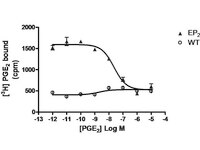
Prostanoids bind to a family of 8 GPCRs to exert their biological effects (Narumiya and FitzGerald, 2001). The protanoid PGE2 causes pain, vasodilation, immunosuppression of T cells, bone resorption and promotion of carcinogenesis. Four related GPCRs, EP1, EP2, EP3 and EP4, each bind to PGE2, but the different G protein coupling status of each receptor leads to distinct biological effects. EP2 couples primarily to Gs to increase intracellular cAMP levels. Mice deficient in EP2 receptor showed impaired ovulation and fertilization, salt-sensitive hypertension (Kennedy et al., 1999). It has been shown that EP2 receptors are also involved in cancer associated immunodeficiency. Thus, genetic knockout of the EP2 receptor reduced tumor growth and prolonged survival in mice that had undergone isograft injection of MC26 or Lewis lung carcinoma cells (Yang et al., 2003). Millipore's EP2 membrane preparations are crude membrane preparations made from our proprietary stable recombinant cell lines to ensure high-level of GPCR surface expression; thus, they are ideal HTS tools for screening of agonists and antagonists of EP2. The membrane preparations exhibit a Kd of 14.52 nM for [3H]-PGE2. With 7.5 nM [3H]-PGE2, 10µg/well EP2 Membrane Prep typically yields greater than 3-fold signal-to-background ratio.
References
Product Information
Format
Membranes
Presentation
Liquid in packaging buffer: 50 mM Tris pH 7.4, 10% glycerol and 1% BSA with no preservatives. Packaging method: Membranes protein were adjusted to the indicated concentration in packaging buffe, rapidly frozen, and stored at -80°C.
FUNCTION: SwissProt: P43116 # Receptor for prostaglandin E2 (PGE2). The activity of this receptor is mediated by G(s) proteins that stimulate adenylate cyclase. The subsequent raise in intracellular cAMP is responsible for the relaxing effect of this receptor on smooth muscle. SIZE: 358 amino acids; 39761 Da SUBCELLULAR LOCATION: Cell membrane; Multi-pass membrane protein. TISSUE SPECIFICITY: Placenta and lung. SIMILARITY: SwissProt: P43116 ## Belongs to the G-protein coupled receptor 1 family.
Incubation Conditions
Membranes are mixed with radioactive ligand and unlabeled competitor (see Figures 1 and 2 for concentrations tested) in binding buffer in a nonbinding 96-well plate, and incubated for 1-2 h. Prior to filtration, a GF/C 96-well filter plate is coated with 0.33% polyethyleneimine for 30 min, then washed with 50mM HEPES, pH 7.4, 500mM NaCl. Binding reaction is transferred to the filter plate, and washed 3 times (1 mL per well per wash) with Wash Buffer. The plate is dried and counted. Binding buffer: 50 mM Hepes, pH 7.4, 5 mM MgCl2, 1 mM CaCl2, filtered and stored at 4°C. Radioligand: [3H]-PGE2 (Perkin Elmer#: NET-428) Wash Buffer: 50 mM Hepes, pH 7.4, 500mM NaCl, filtered and stored at 4°C.
Physicochemical Information
Dimensions
Materials Information
Toxicological Information
Safety Information according to GHS
Safety Information
Product Usage Statements
Table 1. Signal:background and specific binding values obtained in a competition binding assay with varying amounts of EP2 Receptor membrane prep.
10 µg/well
Signal:Background
3.60
Specific Binding (cpm)
1146
1 unit = 10 µg Bmax for [3H]-PGE2 binding: 4.38 pmol/mg protein Kd for [3H]-PGE2 binding: ~14.52 nM
Usage Statement
Unless otherwise stated in our catalog or other company documentation accompanying the product(s), our products are intended for research use only and are not to be used for any other purpose, which includes but is not limited to, unauthorized commercial uses, in vitro diagnostic uses, ex vivo or in vivo therapeutic uses or any type of consumption or application to humans or animals.
Storage and Shipping Information
Storage Conditions
Store at –70°C. Product is stable for at least 6 months from the date of receipt when stored as directed. Do not freeze and thaw.
Packaging Information
Material Size
200 units
Transport Information
Supplemental Information
Specifications
Global Trade Item Number
Bestellnummer
GTIN
HTS185M
04053252739262
Documentation
ChemiSCREEN™ Membrane Preparation Recombinant Human EP2 Prostanoid Receptor SDB
Cancer-associated immunodeficiency and dendritic cell abnormalities mediated by the prostaglandin EP2 receptor Yang, Li, et al J Clin Invest, 111:727-35 (2003)
2003
Salt-sensitive hypertension and reduced fertility in mice lacking the prostaglandin EP2 receptor. Kennedy, C R, et al. Nat. Med., 5: 217-20 (1999)
1998
Prostaglandins (PGs) are ubiquitous lipid mediators derived from cyclooxygenase metabolism of arachidonic acid that exert a broad range of physiologic activities, including modulation of inflammation, ovulation and arterial blood pressure. PGE2, a chief cyclooxygenase product, modulates blood pressure and fertility, although the specific G protein-coupled receptors mediating these effects remain poorly defined. To evaluate the physiologic role of the PGE2 EP2 receptor subtype, we created mice with targeted disruption of this gene (EP2-/-). EP2-/- mice develop normally but produce small litters and have slightly elevated baseline systolic blood pressure. In EP2-/- mice, the characteristic hypotensive effect of intravenous PGE2 infusion was absent; PGE2 infusion instead produced hypertension. When fed a diet high in salt, the EP2-/- mice developed profound systolic hypertension, whereas wild-type mice showed no change in systolic blood pressure. Analysis of wild-type and EP2-/- mice on day 5 of pregnancy indicated that the reduced litter size of EP2-/- mice is due to a pre-implantation defect. This reduction of implanted embryos could be accounted for by impaired ovulation and dramatic reductions in fertilization observed on day 2 of pregnancy. These data demonstrate that the EP2 receptor mediates arterial dilatation, salt-sensitive hypertension, and also plays an essential part in female fertility.
Millipore offers a large selection of robust and reliable G-protein coupled receptor products, including Stable Cell Lines, Membrane Preparations, and Frozen Cells. See below for GPCR research tools. Weitere Informationen >>