Millipore Sigma Vibrant Logo

PS1019 PhosphoDetect™ Anti-JNK1/2 (pThr¹⁸³/Tyr¹⁸⁵) Rabbit pAb
Übersicht

Replacement Information

Key Spec Table

Species ReactivityHostAntibody Type
H, M, RRbPolyclonal Antibody

Preis & Verfügbarkeit

Bestellnummer VerfügbarkeitVerpackung St./Pkg. Preis Menge
PS1019-100UL
Verfügbarkeit wird abgerufen...
Eingeschränkte Verfügbarkeit
Lieferbar 
Produkt wurde eingestellt
Begrenzter Lagerbestand
Bestätigung der Verfügbarkeit erforderlich
    Restmenge: Angebot folgt
      Restmenge: Angebot folgt
      Bitte erfragen
      Kontakt zum Kundenservice
      Contact Customer Service

      Kst.-Ampulle 100 ul
      Preis wird abgerufen...
      Preis nicht abrufbar
      Die Mindestmenge muss ein Vielfaches sein von
      Maximum Quantity is
      Bei Bestätigung Weitere Informationen
      Sie haben () gespart
       
      Bitte erfragen
      Description
      OverviewRecognizes the ~49 kDa JNK1 and the ~55 kDa JNK2 phosphorylated at Thr183 and Tyr185 in uv-treated HEK293 cells.
      Catalogue NumberPS1019
      Brand Family Calbiochem®
      SynonymsAnti-c-Jun N-terminal Kinase 1&2, Phospho-Specific (Thr/Tyr183/185)
      Application Data
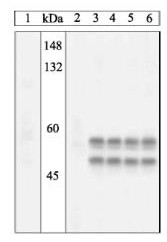
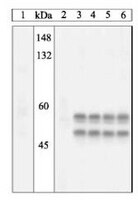
      Detection of human JNK1 and JNK2, phosphorylated at Thr183 and Tyr185, by immunoblotting. Samples: Whole cell lysate from HEK293 cells left untreated (lane 1) or treated with UV irradiation (lanes 2-6). Primary antibody: PhosphoDetect™ Anti-JNK1&2 (pThr183/pTyr185 Rabbit pAb (Cat. No. PS1019) (1:1000) pre-incubated without peptide (lanes 1,6), with the phosphopeptide immunogen (lane 2), a generic phosphothreonine-containing peptide (lane 3), a generic phosphotyrosine-containing peptide (lane 4), or non-phosphopeptide corresponding to the immunogen (lane 5). Detection: chemiluminescence.
      References
      ReferencesChoudhury, B.K., et al. 2002. J. Immunol. 169, 5955.
      Barr, R.K., et al. 2001. Int. J. Biochem. Cell. Biol. 33, 1047.
      Dong, C., et al. 2001. J. Clin. Immunol. 21, 253.
      Janulis, M., et al. 2001. Mol. Cell. Biol. 21, 2235.
      Pearce, A.K., et al. 2001. Trends Cell Biol. 11, 426.
      Tong, T., et al. 2001. Exp. Cell Res. 269, 64.
      Cobb, M.H., et al. 1999. Prog. Biophys. Mol. Biol. 71, 479.
      Basu, S., et al. 1998. Oncogene 17, 3277.
      Product Information
      FormLiquid
      FormulationIn Dulbecco's PBS (without Mg2+ and Ca2+), 1 mg/ml BSA, 50% glycerol, pH 7.2-7.4.
      Positive controlUV-treated HEK293 cells or sorbitol-treated PC12 cells
      Preservative≤0.1% sodium azide
      Quality LevelMQ100
      Applications
      Key Applications Immunoblotting (Western Blotting)
      Application NotesImmunoblotting (1:1000)
      Application CommentsThe immunogen sequence is highly conserved among many species, including mouse, rat, chicken, nematode, and Drosophila, but cross-reactivity has not been determined. The immunogen sequence is also conserved in JNK3, but reactivity has not been detected. Antibody should be titrated for optimal results in individual systems.
      Biological Information
      Immunogena synthetic phosphopeptide corresponding to amino acids surrounding the Thr¹⁸³ and Tyr¹⁸⁵ phosphorylation sites of human JNK1 and JNK2
      ImmunogenHuman
      HostRabbit
      IsotypeIgG
      Species Reactivity
      • Human
      • Mouse
      • Rat
      Antibody TypePolyclonal Antibody
      Physicochemical Information
      Dimensions
      Materials Information
      Toxicological Information
      Safety Information according to GHS
      Safety Information
      Product Usage Statements
      Storage and Shipping Information
      Ship Code Shipped with Blue Ice or with Dry Ice
      Toxicity Standard Handling
      Storage -20°C
      Avoid freeze/thaw Avoid freeze/thaw
      Do not freeze Ok to freeze
      Special InstructionsFollowing initial thaw, aliquot and freeze (-20°C).
      Packaging Information
      Transport Information
      Supplemental Information
      Specifications
      Global Trade Item Number
      Bestellnummer GTIN
      PS1019-100UL 04055977227109

      Documentation

      PhosphoDetect™ Anti-JNK1/2 (pThr¹⁸³/Tyr¹⁸⁵) Rabbit pAb SDB

      Titel

      Sicherheitsdatenblatt (SDB) 

      PhosphoDetect™ Anti-JNK1/2 (pThr¹⁸³/Tyr¹⁸⁵) Rabbit pAb Analysenzertifikate

      TitelChargennummer
      PS1019

      Literatur

      Übersicht
      Choudhury, B.K., et al. 2002. J. Immunol. 169, 5955.
      Barr, R.K., et al. 2001. Int. J. Biochem. Cell. Biol. 33, 1047.
      Dong, C., et al. 2001. J. Clin. Immunol. 21, 253.
      Janulis, M., et al. 2001. Mol. Cell. Biol. 21, 2235.
      Pearce, A.K., et al. 2001. Trends Cell Biol. 11, 426.
      Tong, T., et al. 2001. Exp. Cell Res. 269, 64.
      Cobb, M.H., et al. 1999. Prog. Biophys. Mol. Biol. 71, 479.
      Basu, S., et al. 1998. Oncogene 17, 3277.
      Datenblatt

      Note that this data sheet is not lot-specific and is representative of the current specifications for this product. Please consult the vial label and the certificate of analysis for information on specific lots. Also note that shipping conditions may differ from storage conditions.

      Revision17-October-2007 RFH
      SynonymsAnti-c-Jun N-terminal Kinase 1&2, Phospho-Specific (Thr/Tyr183/185)
      ApplicationImmunoblotting (1:1000)
      Application Data
      Detection of human JNK1 and JNK2, phosphorylated at Thr183 and Tyr185, by immunoblotting. Samples: Whole cell lysate from HEK293 cells left untreated (lane 1) or treated with UV irradiation (lanes 2-6). Primary antibody: PhosphoDetect™ Anti-JNK1&2 (pThr183/pTyr185 Rabbit pAb (Cat. No. PS1019) (1:1000) pre-incubated without peptide (lanes 1,6), with the phosphopeptide immunogen (lane 2), a generic phosphothreonine-containing peptide (lane 3), a generic phosphotyrosine-containing peptide (lane 4), or non-phosphopeptide corresponding to the immunogen (lane 5). Detection: chemiluminescence.
      DescriptionRabbit polyclonal antibody adsorbed against non-phosphopeptide corresponding to the immunogen phosphorylation site, followed by immunoaffinity chromatography. Recognizes the ~49 kDa JNK1 and the ~55 kDa JNK2 proteins phosphorylated at Thr183 and Tyr185.
      Backgroundc-Jun N-terminal Kinase (JNK) is a Stress Activated Protein Kinase/MAP Kinase (SAPK/MAPK) that exists as three isoforms, JNK1 (~49 kDa), JNK2 (~55 kDa), and JNK3 (~54 kDa). JNK is activated as a result of phosphorylation on Thr183 and Tyr185 by MEK4 and MEK7. JNK1 and JNK2 are expressed by numerous cells and tissues, while JNK3 is primarily expressed in neuronal cells. The JNK pathway, along with the p38 pathway, functions to modulate cell cycle, apoptotic, and transcriptional responses to stress.
      HostRabbit
      Immunogen speciesHuman
      Immunogena synthetic phosphopeptide corresponding to amino acids surrounding the Thr¹⁸³ and Tyr¹⁸⁵ phosphorylation sites of human JNK1 and JNK2
      IsotypeIgG
      Specieshuman, mouse, rat
      Positive controlUV-treated HEK293 cells or sorbitol-treated PC12 cells
      FormLiquid
      FormulationIn Dulbecco's PBS (without Mg2+ and Ca2+), 1 mg/ml BSA, 50% glycerol, pH 7.2-7.4.
      Preservative≤0.1% sodium azide
      CommentsThe immunogen sequence is highly conserved among many species, including mouse, rat, chicken, nematode, and Drosophila, but cross-reactivity has not been determined. The immunogen sequence is also conserved in JNK3, but reactivity has not been detected. Antibody should be titrated for optimal results in individual systems.
      Storage Avoid freeze/thaw
      -20°C
      Do Not Freeze Ok to freeze
      Special InstructionsFollowing initial thaw, aliquot and freeze (-20°C).
      Toxicity Standard Handling
      ReferencesChoudhury, B.K., et al. 2002. J. Immunol. 169, 5955.
      Barr, R.K., et al. 2001. Int. J. Biochem. Cell. Biol. 33, 1047.
      Dong, C., et al. 2001. J. Clin. Immunol. 21, 253.
      Janulis, M., et al. 2001. Mol. Cell. Biol. 21, 2235.
      Pearce, A.K., et al. 2001. Trends Cell Biol. 11, 426.
      Tong, T., et al. 2001. Exp. Cell Res. 269, 64.
      Cobb, M.H., et al. 1999. Prog. Biophys. Mol. Biol. 71, 479.
      Basu, S., et al. 1998. Oncogene 17, 3277.