Millipore Sigma Vibrant Logo

CA1001 Anti-BRST-2 Mouse mAb (D6)

CA1001
  
Recuperando precio...
No pudo obtenerse el precio
La cantidad mínima tiene que ser múltiplo de
Maximum Quantity is
Al finalizar el pedido Más información
Ahorró ()
 
Solicitar precio
Disponibilidad a confirmar
Ingrese cantidad 
Suspendido
Cantidades limitadas disponibles
Debe confirmarse disponibilidad
    El resto: se avisará
      El resto: se avisará
      Se avisará
      Póngase en contacto con el Servicio de Atención al Cliente
      Contact Customer Service


      Póngase en contacto con el Servicio de Atención al Cliente

      Descripción

      Replacement Information

      Tabla espec. clave

      Host
      M
      Description
      Overview

      This product has been discontinued.


      Recognizes the ~15 kDa BRST-2 protein in axilla or breast carcinoma tissue.
      Catalogue NumberCA1001
      Brand Family Calbiochem®
      SynonymsAnti-GCDFP-15, Anti-Gross Cystic Disease Fluid Protein-15
      Application Data
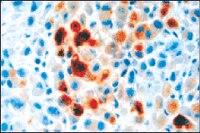
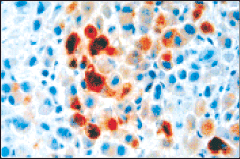
      Detection of human BRST-2 by staining paraffin sections. Sample: Breast carcinoma. Primary antibody: Anti-BRST-2 Mouse mAb (D6) (Cat. No. CA1001) (>1:40). Detection: DAB.
      References
      ReferencesSwanson, P.E., et al. 1991. Arch. Pathol. Lab. Med. 115, 158.
      Mazoujian, G., et al. 1988. J. Histochem. Cytochem. 36, 377.
      Product Information
      FormLiquid
      FormulationIn PBS, 1% BSA.
      Positive controlAxilla or breast carcinoma tissue
      Preservative≤0.1% sodium azide
      Applications
      Key Applications Paraffin Sections
      Application NotesParaffin Sections (>1:40, no pre-treatment required, see comments)
      Application CommentsWorks for formalin-fixed paraffin-embedded tissues; no pre-treatment is required. Primary antibody may be diluted >1:40 for biotin based detection systems. For optimal staining, the primary antibody should be incubated 20-60 min at room temperature. Antibody should be titrated for optimal results in individual systems.
      Biological Information
      ImmunogenBRST-2 protein from gross cystic disease fluid
      ImmunogenHuman
      CloneD6
      HostMouse
      IsotypeIgG2a
      Concentration Label Please refer to vial label for lot-specific concentration
      Physicochemical Information
      Dimensions
      Materials Information
      Toxicological Information
      Safety Information according to GHS
      Safety Information
      Product Usage Statements
      Storage and Shipping Information
      Ship Code Blue Ice Only
      Toxicity Highly Toxic
      Storage +2°C to +8°C
      Do not freeze Ok to freeze
      Special InstructionsFollowing initial use, aliquot and freeze (-20°C) for long-term storage if desired. Avoid freeze/thaw cycles.
      Packaging Information
      Transport Information
      Supplemental Information
      Specifications
      Global Trade Item Number
      Número de referencia GTIN
      CA1001 0

      Documentation

      Referencias bibliográficas

      Visión general referencias
      Swanson, P.E., et al. 1991. Arch. Pathol. Lab. Med. 115, 158.
      Mazoujian, G., et al. 1988. J. Histochem. Cytochem. 36, 377.
      Ficha técnica

      Note that this data sheet is not lot-specific and is representative of the current specifications for this product. Please consult the vial label and the certificate of analysis for information on specific lots. Also note that shipping conditions may differ from storage conditions.

      Revision20-August-2007 RFH
      SynonymsAnti-GCDFP-15, Anti-Gross Cystic Disease Fluid Protein-15
      ApplicationParaffin Sections (>1:40, no pre-treatment required, see comments)
      Application Data
      Detection of human BRST-2 by staining paraffin sections. Sample: Breast carcinoma. Primary antibody: Anti-BRST-2 Mouse mAb (D6) (Cat. No. CA1001) (>1:40). Detection: DAB.
      DescriptionPurified mouse monoclonal antibody. Recognizes the ~15 kDa BRST-2 protein.
      BackgroundGross cystic disease is characterized by an accumulation of secreted fluid in breast cysts. This fluid is made up of several glycoproteins, including the monomer protein gross cystic disease fluid protein-15 (GCDFP-15). GCDFP-15 is a useful marker for the detection of breast carcinoma and the identification of metastasis of breast origin.
      HostMouse
      Immunogen speciesHuman
      ImmunogenBRST-2 protein from gross cystic disease fluid
      CloneD6
      IsotypeIgG2a
      Specieshuman
      Positive controlAxilla or breast carcinoma tissue
      FormLiquid
      FormulationIn PBS, 1% BSA.
      Concentration Label Please refer to vial label for lot-specific concentration
      Preservative≤0.1% sodium azide
      CommentsWorks for formalin-fixed paraffin-embedded tissues; no pre-treatment is required. Primary antibody may be diluted >1:40 for biotin based detection systems. For optimal staining, the primary antibody should be incubated 20-60 min at room temperature. Antibody should be titrated for optimal results in individual systems.
      Storage +2°C to +8°C
      Do Not Freeze Ok to freeze
      Special InstructionsFollowing initial use, aliquot and freeze (-20°C) for long-term storage if desired. Avoid freeze/thaw cycles.
      Toxicity Highly Toxic
      ReferencesSwanson, P.E., et al. 1991. Arch. Pathol. Lab. Med. 115, 158.
      Mazoujian, G., et al. 1988. J. Histochem. Cytochem. 36, 377.