Millipore Sigma Vibrant Logo

ST1549 Anti-FASN Mouse mAb (3F2-1F3)

Descripción

Replacement Information

Tabla espec. clave

Species ReactivityHostAntibody Type
HMMonoclonal Antibody

Precios y disponibilidad

Número de referencia DisponiblidadEmbalaje Cant./Env. Precio Cantidad
ST1549-50UG
Comprobando disponibilidad...
Disponibilidad a confirmar
Ingrese cantidad 
Suspendido
Cantidades limitadas disponibles
Debe confirmarse disponibilidad
    El resto: se avisará
      El resto: se avisará
      Se avisará
      Póngase en contacto con el Servicio de Atención al Cliente
      Contact Customer Service

      50 μg
      Recuperando precio...
      No pudo obtenerse el precio
      La cantidad mínima tiene que ser múltiplo de
      Maximum Quantity is
      Al finalizar el pedido Más información
      Ahorró ()
       
      Solicitar precio
      Description
      OverviewRecognizes the FASN protein in 293 and HeLa cells and human breast carcinoma tissue.
      Catalogue NumberST1549
      Brand Family Calbiochem®
      SynonymsAnti-Fatty Acid Synthase
      Application Data
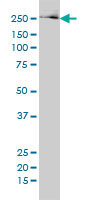
      Detection of human FASN by immunoblotting. Sample: Whole cell lysate from 293 cells. Primary antibody: Anti-FASN Mouse mAb (3F2-1F3) (Cat. No. ST1549) (1-5 µg/ml). Detection: chemiluminescence.

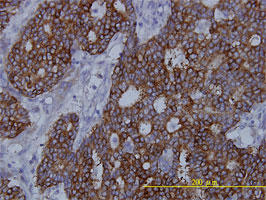
      Detection of human FASN by staining paraffin sections. Sample: Formalin-fixed paraffin-embedded human breast cancer tissue. Primary antibody: Anti-FASN Mouse mAb (3F2-1F3) (Cat. No. ST1549) (10 µg/ml). Detection: colorimetric (DAB).

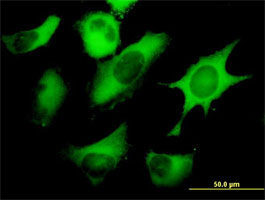
      Detection of human FASN by immuncytochemistry. Sample: HeLa cells fixed in paraformaldehyde. Primary antibody: Anti-FASN Mouse mAb (3F2-1F3) (Cat. No. ST1549) (10 µg/ml). Detection: fluorescence.
      References
      ReferencesKristiansen, G., et al. 2010. Br. J. Cancer 102, 1736.
      Product Information
      FormLiquid
      FormulationIn PBS, pH 7.2.
      Positive control293 cells, HeLa cells, Human breast carcinoma tissue
      PreservativeNone
      Quality LevelMQ100
      Applications
      Key Applications Enzyme-Linked Immunosorbent Assay
      Immunoblotting (Western Blotting)
      Immunocytochemistry
      Paraffin Sections
      Application NotesELISA (see coments)
      Immunoblotting (1-5 µg/ml)
      Immunocytochemistry (10 µg/ml)
      Paraffin Sections (10 µg/ml)
      Application CommentsFor ELISA, this antibody can be used as the capture antibody; recommended concentration is 10 ng/ml, 1 µg/well, 100 µl total volume. Variables associated with assay conditions will dictate the proper working dilution.
      Biological Information
      ImmunogenFull-length, recombinant human FASN (aa 1-440) expressed as GST fusion protein
      Clone3F2-1F3
      HostMouse
      IsotypeIgG1
      Species Reactivity
      • Human
      Antibody TypeMonoclonal Antibody
      Physicochemical Information
      Dimensions
      Materials Information
      Toxicological Information
      Safety Information according to GHS
      Safety Information
      Product Usage Statements
      Storage and Shipping Information
      Ship Code Blue Ice Only
      Toxicity Regulatory Review
      Storage -20°C
      Avoid freeze/thaw Avoid freeze/thaw
      Do not freeze Ok to freeze
      Special InstructionsFollowing initial thaw, aliquot and freeze (-20°C).
      Packaging Information
      Transport Information
      Supplemental Information
      Specifications
      Global Trade Item Number
      Número de referencia GTIN
      ST1549-50UG 04055977224252

      Documentation

      Anti-FASN Mouse mAb (3F2-1F3) Ficha datos de seguridad (MSDS)

      Título

      Ficha técnica de seguridad del material (MSDS) 

      Anti-FASN Mouse mAb (3F2-1F3) Certificados de análisis

      CargoNúmero de lote
      ST1549

      Referencias bibliográficas

      Visión general referencias
      Kristiansen, G., et al. 2010. Br. J. Cancer 102, 1736.
      Ficha técnica

      Note that this data sheet is not lot-specific and is representative of the current specifications for this product. Please consult the vial label and the certificate of analysis for information on specific lots. Also note that shipping conditions may differ from storage conditions.

      Revision26-May-2010 RFH
      SynonymsAnti-Fatty Acid Synthase
      ApplicationELISA (see coments)
      Immunoblotting (1-5 µg/ml)
      Immunocytochemistry (10 µg/ml)
      Paraffin Sections (10 µg/ml)
      Application Data
      Detection of human FASN by immunoblotting. Sample: Whole cell lysate from 293 cells. Primary antibody: Anti-FASN Mouse mAb (3F2-1F3) (Cat. No. ST1549) (1-5 µg/ml). Detection: chemiluminescence.

      Detection of human FASN by staining paraffin sections. Sample: Formalin-fixed paraffin-embedded human breast cancer tissue. Primary antibody: Anti-FASN Mouse mAb (3F2-1F3) (Cat. No. ST1549) (10 µg/ml). Detection: colorimetric (DAB).

      Detection of human FASN by immuncytochemistry. Sample: HeLa cells fixed in paraformaldehyde. Primary antibody: Anti-FASN Mouse mAb (3F2-1F3) (Cat. No. ST1549) (10 µg/ml). Detection: fluorescence.
      DescriptionPurified mouse monoclonal antibody. Recognizes the FASN protein.
      BackgroundFASN is a multifunctional protein. Its main function is to catalyze the synthesis of palmitate from acetyl-CoA and malonyl-CoA, in the presence of NADPH, into long-chain saturated fatty acids. In some cancer cell lines, this protein has been found to be fused with estrogen receptor-alpha (ER-α), in which the N-terminus of FAS is fused in-frame with the C-terminus of ER-α.
      HostMouse
      ImmunogenFull-length, recombinant human FASN (aa 1-440) expressed as GST fusion protein
      Clone3F2-1F3
      IsotypeIgG1
      Specieshuman
      Positive control293 cells, HeLa cells, Human breast carcinoma tissue
      FormLiquid
      FormulationIn PBS, pH 7.2.
      PreservativeNone
      CommentsFor ELISA, this antibody can be used as the capture antibody; recommended concentration is 10 ng/ml, 1 µg/well, 100 µl total volume. Variables associated with assay conditions will dictate the proper working dilution.
      Storage Avoid freeze/thaw
      -20°C
      Do Not Freeze Ok to freeze
      Special InstructionsFollowing initial thaw, aliquot and freeze (-20°C).
      Toxicity Regulatory Review
      ReferencesKristiansen, G., et al. 2010. Br. J. Cancer 102, 1736.