Millipore Sigma Vibrant Logo

ST1102 Anti-Kpnβ₁ Rabbit pAb

View Products on Sigmaaldrich.com
ST1102
  
Recuperando precio...
No pudo obtenerse el precio
La cantidad mínima tiene que ser múltiplo de
Maximum Quantity is
Al finalizar el pedido Más información
Ahorró ()
 
Solicitar precio
Disponibilidad a confirmar
Ingrese cantidad 
Suspendido
Cantidades limitadas disponibles
Debe confirmarse disponibilidad
    El resto: se avisará
      El resto: se avisará
      Se avisará
      Póngase en contacto con el Servicio de Atención al Cliente
      Contact Customer Service


      Póngase en contacto con el Servicio de Atención al Cliente

      Descripción

      Replacement Information

      Tabla espec. clave

      Species ReactivityHostAntibody Type
      H, M, XnRbPolyclonal Antibody
      Description
      Overview

      This product has been discontinued.


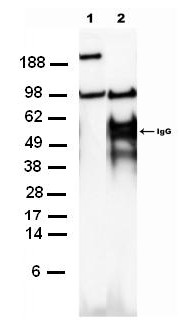
      Recognizes the ~97 kDa Kpnβ1 protein in Jurkat cells.

      Catalogue NumberST1102
      Brand Family Calbiochem®
      SynonymsAnti-Karyopherin-β₁, Anti-Importin-β₁, Anti-Kapβ₁, Anti-Nuclear factor p97
      Application Data
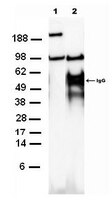
      Lane 1: Detection of human Kpnβ1 by immunoblotting. Sample: Whole cell lysate (50 µg) from Jurkat cells. Primary antibody: Anti-Kpnβ1 Rabbit pAb (Cat. No. ST1102) (0.3 µg/ml). Detection: chemiluminescence. Lane 2: Detection of human Kpnβ1 by immunoprecipitation followed by immunoblotting. Sample: Whole cell lysate from Jurkat cells. Antibody for IP: Anti-Kpnβ1 Rabbit pAb (Cat. No. ST1102) (5 µg/500 µg total protein in 500 µl). Immunoblotting conditions: same as Lane 1.
      References
      ReferencesChook, Y.M. and Blobel. G. 2001. Curr. Opin. Struct. Biol. 11, 703;
      Miroianu, J., et al. 1995. Proc. Natl. Acad. Sci. USA 92, 6532;
      Gorlich, D., et al. 1995. Nature 377, 246.
      Product Information
      FormLiquid
      FormulationIn Tris-citrate/phosphate buffer, pH 7-8.
      Positive controlJurkat cells
      Preservative≤0.1% sodium azide
      Quality LevelMQ100
      Applications
      Key Applications Immunoblotting (Western Blotting)
      Immunoprecipitation
      Application NotesImmunoblotting (1:5000-1:15,000)
      Immunoprecipitation (2-5 µg/mg lysate)
      Application CommentsAntibody should be titrated for optimal results in individual systems.
      Biological Information
      Immunogena synthetic peptide corresponding to amino acids near the C-terminus of human Kpnβ₁
      ImmunogenHuman
      HostRabbit
      IsotypeIgG
      Species Reactivity
      • Human
      • Mouse
      • Xenopus
      Antibody TypePolyclonal Antibody
      Concentration Label Please refer to vial label for lot-specific concentration
      Physicochemical Information
      Dimensions
      Materials Information
      Toxicological Information
      Safety Information according to GHS
      Safety Information
      Product Usage Statements
      Storage and Shipping Information
      Ship Code Blue Ice Only
      Toxicity Standard Handling
      Storage -20°C
      Avoid freeze/thaw Avoid freeze/thaw
      Do not freeze Ok to freeze
      Special InstructionsFollowing initial thaw, aliquot and freeze (-20°C).
      Packaging Information
      Transport Information
      Supplemental Information
      Specifications
      Global Trade Item Number
      Número de referencia GTIN
      ST1102 0

      Documentation

      Anti-Kpnβ₁ Rabbit pAb Ficha datos de seguridad (MSDS)

      Título

      Ficha técnica de seguridad del material (MSDS) 

      Referencias bibliográficas

      Visión general referencias
      Chook, Y.M. and Blobel. G. 2001. Curr. Opin. Struct. Biol. 11, 703;
      Miroianu, J., et al. 1995. Proc. Natl. Acad. Sci. USA 92, 6532;
      Gorlich, D., et al. 1995. Nature 377, 246.
      Ficha técnica

      Note that this data sheet is not lot-specific and is representative of the current specifications for this product. Please consult the vial label and the certificate of analysis for information on specific lots. Also note that shipping conditions may differ from storage conditions.

      Revision11-August-2008 RFH
      SynonymsAnti-Karyopherin-β₁, Anti-Importin-β₁, Anti-Kapβ₁, Anti-Nuclear factor p97
      ApplicationImmunoblotting (1:5000-1:15,000)
      Immunoprecipitation (2-5 µg/mg lysate)
      Application Data
      Lane 1: Detection of human Kpnβ1 by immunoblotting. Sample: Whole cell lysate (50 µg) from Jurkat cells. Primary antibody: Anti-Kpnβ1 Rabbit pAb (Cat. No. ST1102) (0.3 µg/ml). Detection: chemiluminescence. Lane 2: Detection of human Kpnβ1 by immunoprecipitation followed by immunoblotting. Sample: Whole cell lysate from Jurkat cells. Antibody for IP: Anti-Kpnβ1 Rabbit pAb (Cat. No. ST1102) (5 µg/500 µg total protein in 500 µl). Immunoblotting conditions: same as Lane 1.
      DescriptionImmunoaffinity purified rabbit polyclonal antibody. Recognizes the ~97 kDa Kpnβ1 protein.
      BackgroundFull-length Kpnβ1 (Accession # NP_002256) consists of 19 HEAT repeats that form a compact superhelical coil. While other members of the Kpnβ family bind their substrates directly, Kpnβ1 uses Kpnα as an adaptor for binding substrates that contain a classical NLS. However, Kpnβ1 can also import some substrates, such as HIV Rev, GAL4, T-cell tyrosine phosphatase, cyclin B1, and parathyroid hormone-related protein (PTHrP), without binding Kpnα. Kpnβ1 docks the complex at the cytoplasmic side of the nuclear pore complex. In the presence of nucleoside triphosphates and the small GTP binding protein Ran, the complex moves into the nuclear pore complex and the importin subunits dissociate. Importinα enters the nucleoplasm with its passenger protein and importinβ remains at the pore. Interactions between Kpnβ1 and the FG repeats of nucleoporins are essential in translocation through the pore complex.
      HostRabbit
      Immunogen speciesHuman
      Immunogena synthetic peptide corresponding to amino acids near the C-terminus of human Kpnβ₁
      IsotypeIgG
      SpeciesXenopus, human, mouse
      Positive controlJurkat cells
      FormLiquid
      FormulationIn Tris-citrate/phosphate buffer, pH 7-8.
      Concentration Label Please refer to vial label for lot-specific concentration
      Preservative≤0.1% sodium azide
      CommentsAntibody should be titrated for optimal results in individual systems.
      Storage Avoid freeze/thaw
      -20°C
      Do Not Freeze Ok to freeze
      Special InstructionsFollowing initial thaw, aliquot and freeze (-20°C).
      Toxicity Standard Handling
      ReferencesChook, Y.M. and Blobel. G. 2001. Curr. Opin. Struct. Biol. 11, 703;
      Miroianu, J., et al. 1995. Proc. Natl. Acad. Sci. USA 92, 6532;
      Gorlich, D., et al. 1995. Nature 377, 246.