Millipore Sigma Vibrant Logo

MABC1182 Anti-Serpina3n Antibody, clone 13H5

View Products on Sigmaaldrich.com
MABC1182
100 μg  
Recuperando precio...
No pudo obtenerse el precio
La cantidad mínima tiene que ser múltiplo de
Maximum Quantity is
Al finalizar el pedido Más información
Ahorró ()
 
—
Solicitar precio
—
Disponibilidad a confirmar
Ingrese cantidad 
Suspendido
Cantidades limitadas disponibles
Debe confirmarse disponibilidad
    El resto: se avisará
      El resto: se avisará
      Se avisará
      Póngase en contacto con el Servicio de Atención al Cliente
      Contact Customer Service


      Póngase en contacto con el Servicio de Atención al Cliente

      Descripción

      Replacement Information

      Tabla espec. clave

      Species ReactivityKey ApplicationsHostFormatAntibody Type
      MWB, IFAHmPurifiedMonoclonal Antibody
      Description
      Catalogue NumberMABC1182
      DescriptionAnti-Serpina3n Antibody, clone 13H5
      Alternate Names
      • Serine protease inhibitor A3N
      Background InformationSerine protease inhibitor A3N (UniProt: Q91WP6; also known as Serpin A3N) is encoded by the Serpina3n (also known as Spi2) gene (Gene ID: 20716) in murine species. SerpinA3N is a secreted protein of the serpin family. Serpins bind and inhibit specific serine proteases and several serine proteases are reported to be substrates for SerpinA3N in vitro. It is synthesized with a signal peptide of 20 amino acids that is cleaved to generate the mature protein. SerpinA3N is expressed at high levels in brain, heart, liver, lung, spleen, testis, and thymus. However, its expression is low in kidney, skeletal muscle, and bone marrow. Serpin A3N expression can also be induced by bacterial lipopolysaccharides. The reactive center loop (RCL) of as SerpinA3N extends out from the body of the protein and directs binding to the target protease. The protease cleaves the serpin at the reactive site within the RCL, establishing a covalent linkage between the serpin reactive site and the protease. The resulting inactive serpin-protease complex is highly stable. SerpinA3N is shown to be up-regulated in the dorsal root ganglia after nerve injury and mice lacking SerpinA3N are reported to develop more neuropathic mechanical allodynia than wild-type (WT) mice. SerpinA3N is also shown to attenuate activated T cell-mediated neuronal death and reduce the severity of disease in experimental autoimmune encephalomyelitis (EAE). (Ref.: Vicuna, L et al. (2015) Nat. Med. 21(5):518-23).
      References
      Product Information
      FormatPurified
      HS Code3002 15 90
      PresentationPurified armenian hamster monoclonal antibody in buffer containing 0.1 M Tris-Glycine (pH 7.4), 150 mM NaCl with 0.05% sodium azide.
      Quality LevelMQ100
      Applications
      ApplicationDetect Serpina3n using this armenian hamster monoclonal Anti-Serpina3n Antibody, clone 13H5, Cat. No. MABC1182. It has been tested for use in Immunofluorescence and Western Blotting.
      Key Applications
      • Western Blotting
      • Immunofluorescence
      Application NotesImmunofluorescence Analysis: A representative lot detected increased Serpin A3N/Serpina3n immunoreactivity in late metastasis stage lung tissue by fluorescent immunohistochemistry staining of paraformaldehyde-fixed frozen lung sections in a study employing the murine MMTV-PyMT breast-to-lung metastasis model (Sevenich, L., et al. (2014). Nat. Cell Biol. 16(9):876-888).
      Biological Information
      ImmunogenKLH-conjugated linear peptide corresponding to 24 amino acids from the C-terminal region of murine Serpina3n.
      Clone13H5
      ConcentrationPlease refer to lot specific datasheet.
      HostArmenian Hamster
      SpecificityClone 13H5 specifically targets murine Serpina3n. It is predicted to react with both pro- and mature forms of Serpina3n. This clone targets a sequence within 24 amino acids from the C-terminal region.
      Species Reactivity
      • Mouse
      Species Reactivity NoteMouse. Not Human
      Antibody TypeMonoclonal Antibody
      Entrez Gene Number
      Gene Symbol
      • Serpina3n
      • Spi2
      Purification MethodProtein G purified
      UniProt Number
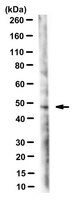
      Molecular Weight~46 kDa observed; 46.72 kDa calculated. Uncharacterized bands may be observed in some lysate(s).
      Physicochemical Information
      Dimensions
      Materials Information
      Toxicological Information
      Safety Information according to GHS
      Safety Information
      Product Usage Statements
      Quality AssuranceEvaluated by Western Blotting in mouse brain tissue lysate.

      Western Blotting Analysis: 0.5 µg/mL of this antibody detected Serpina3n in 10 µg of mouse brain tissue lysate.
      Usage Statement
      • Unless otherwise stated in our catalog or other company documentation accompanying the product(s), our products are intended for research use only and are not to be used for any other purpose, which includes but is not limited to, unauthorized commercial uses, in vitro diagnostic uses, ex vivo or in vivo therapeutic uses or any type of consumption or application to humans or animals.
      Storage and Shipping Information
      Storage ConditionsStable for 1 year at 2-8°C from date of receipt.
      Packaging Information
      Material Size100 μg
      Transport Information
      Supplemental Information
      Specifications
      Global Trade Item Number
      Número de referencia GTIN
      MABC1182 04054839174506

      Documentation

      Anti-Serpina3n Antibody, clone 13H5 Ficha datos de seguridad (MSDS)

      Título

      Ficha técnica de seguridad del material (MSDS) 

      Anti-Serpina3n Antibody, clone 13H5 Certificados de análisis

      CargoNúmero de lote
      Anti-Serpina3n, clone 13H5 - 3327584 3327584
      Anti-Serpina3n, clone 13H5 - 3614832 3614832
      Anti-Serpina3n, clone 13H5 - 3977213 3977213
      Anti-Serpina3n, clone 13H5 - 4082262 4082262
      Anti-Serpina3n, clone 13H5 - 4373577 4373577
      Anti-Serpina3n, clone 13H5 Monoclonal Antibody Q2821212