Millipore Sigma Vibrant Logo

105226 Neofucsina (C.I. 42520)
View Products on Sigmaaldrich.com
105226
Ver precios y disponibilidad

Descripción

Replacement Information
Descripción
Número de catálogo105226
DescripciónNew fuchsin (C.I. 42520)
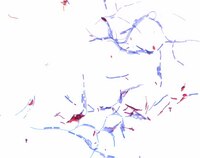
Visión de conjuntoThe dry dye New fuchsin (C.I. 42520) for microscopy Certistain®, is used for the preparation of a staining solution that can be used for staining of histological tissue sections or other samples of human origin according to Ziehl-Neelsen, Gram staining as well as in combination with Schiff’s reagent. As a CERTISTAIN® dye it is chemically quality-certified according to highest standards and strict specifications. New fuchsin belongs to the group of triaminotriphenylmethane dyes.
The dye is used in Ziehl-Neelsen and Gram staining as well as for methods with Schiff’s reagent.
The cell wall of acid-fast bacteria (AFB) has a high proportion of wax and lipids and hence absorbs dyes only very slowly. As a measure to enhance the absorption of the fuchsin dye and thus the formation of the mycolate-fuchsin complex in the cell wall, the carbolfuchsin solution applied to the specimen is normally heated to evaporation point. If the Kinyoun carbolfuchsin solution is used, the heating of the solution is dispensable. Consequently, the release of hazardous phenolic vapors will be avoided.
Once the AFB have absorbed the fuchsin dye, it is virtually impossible to decolorize them again, even when they are intensively treated with a decolorizing solution such as e. g. hydrochloric acid in ethanol. Accordingly, AFB are termed as acid- and alcohol-fast for staining, and are stained red in the microscopic visualization. Correspondingly, all non-acid-fast microorganisms are counterstained with an appropriate dye.
Pretreatment of the specimens with Sputofluol® dissolves the bacteria from the surrounding viscid sputum and cell material. Sputofluol® also has a disinfectant effect, with the result that any microorganisms that are present are killed off. It is registered as IVD and certified as CE product. For more details, please see instructions for use (IFU). The IFU can be downloaded from this webpage.
Referencias bibliográficas
Información del producto
Número de CAS3248-91-7
Número CE 221-831-7
Fórmula HillC₂₂H₂₄ClN₃
Molar Mass365.91 g/mol
Código HS 3212 90 00
Imagen fórmula estructuralImagen fórmula estructural
Quality LevelMQ400
Aplicaciones
Aplicación for microscopy Certistain®
Información biológica
Información fisicoquímica
Valor de pH3 - 4 (10 g/l, H₂O, 20 °C)
Densidad aparente450 kg/m3
Solubilidad10 g/l
Dimensiones
Información de materiales
Información toxicológica
Información de seguridad según el GHS
Pictogramas de peligro Pictogramas de peligro
Pictogramas de peligro
Declaraciones de peligroH315: Provoca irritación cutánea.
H319: Provoca irritación ocular grave.
H335: Puede irritar las vías respiratorias.
H350: Puede provocar cáncer.
H410: Muy tóxico para los organismos acuáticos, con efectos nocivos duraderos.
Consejos de precauciónP201: Solicitar instrucciones especiales antes del uso.
P202: No manipular la sustancia antes de haber leído y comprendido todas las instrucciones de seguridad.
P273: Evitar su liberación al medio ambiente.
P302 + P352: EN CASO DE CONTACTO CON LA PIEL: Lavar con abundante agua.
P305 + P351 + P338: EN CASO DE CONTACTO CON LOS OJOS: Enjuagar con agua cuidadosamente durante varios minutos. Quitar las lentes de contacto cuando estén presentes y pueda hacerse con facilidad. Proseguir con el lavado.
P308 + P313: EN CASO DE exposición manifiesta o presunta: Consultar a un médico.
Palabra de señalizaciónPeligro
RTECSCX9825000
Clase de almacenamiento6.1C Compuestos tóxicos o compuestos que causan efectos crónicos/Combustibles, tóxicos agudos Cat.3
WGKWGK 3 muy contaminante para el agua
Eliminación9
Los compuestos combustibles caracterizados como cancerígenos y como "muy tóxicos" o "tóxicos" (aparte de disolventes): categoría F. Los sulfatos de alquilos son cancerígenos: evitar a toda costa la inhalación y cualquier contacto con la piel. Para su desactivación pueden añadirse, gota a gota mediante un embudo de decantación y agitando intensamente, a una solución concentrada de amoníaco enfriada con hielo (art. 105426). Antes del vertido a categoría D controlar el valor del pH con tiras indicadoras universales (art. 109535).
Información de seguridad
Categorías de peligrocancerígeno
Declaraciones de uso del producto
Información de almacenamiento y transporte
AlmacenamientoAlmacenar entre +2°C y +30°C.
Información sobre embalaje
Información de transporte
Declaración (vía férrea y carretera) ADR, RIDUN 3077 , 9, III
Declaración (transporte aéreo) IATA-DGRUN 3077 , 9, III
Declaración (transporte marítimo) Código IMDGUN 3077 , 9, III, Marine Pollutant: P
Información complementaria
Especificaciones
Dye content (spectrophotometrically)≥ 75 %
Identity (UV/VIS-Spectrum)passes test
Absorption maximum λ max (ethanol 50 %)553 - 556 nm
Spec. Absorptivity A 1%/1cm (λmax; 0.003 g/l; ethanol 50 %)1810 - 2430
TLC-Testpasses test
Loss on drying (110 °C)≤ 10 %
Suitability for microscopypasses test