Millipore Sigma Vibrant Logo

ST1100 Anti-CRM1 Rabbit pAb

ST1100
  
Prix en cours de récupération
Le prix n'a pas pu être récupéré
La quantité minimale doit être un multiple de
Maximum Quantity is
À la validation de la commande Plus d'informations
Vous avez sauvegardé ()
 
Demander le prix
Disponibilité limitée
En stock 
Interrompu(e)
Disponible en quantités limitées
Disponibilité à confirmer
    Pour le restant : Nous vous tiendrons informé
      Pour le restant : Nous vous tiendrons informé
      Nous vous tiendrons informé
      Contacter le Service Clients
      Contact Customer Service


      Contacter le Service Clients

      Aperçu

      Replacement Information

      Tableau de caractéristiques principal

      Host
      Rb
      Description
      Overview

      This product has been discontinued.


      Recognizes the ~100 kDa human CRM1 protein in HeLa cells.
      Catalogue NumberST1100
      Brand Family Calbiochem®
      SynonymsAnti-Chromosome region maintenance 1 protein, Anti-Exportin
      Application Data
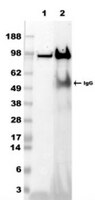
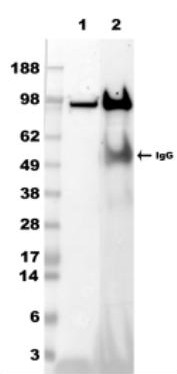
      Lane 1: Detection of human CRM1 by immunoblotting. Sample: Whole cell lysate (50 µg) from HeLa cells. Primary antibody: Anti-CRM1 Rabbit pAb (Cat. No. ST1100) (1 µg/ml). Detection: chemiluminescence. Lane 2: Detection of human CRM1 by immunoprecipitation followed by immunoblotting. Sample: Whole cell lysate from HeLa cells. Antibody for IP: Anti-CRM1 Rabbit pAb (ST1100) (5 µg/500 µg total protein in 500 µl). Immunoblotting conditions: same as Lane 1.
      References
      ReferencesKudo, N., et al. 1998. Exp. Cell Res. 242, 540.
      Fornerod, M., et al. 1997. Cell 90, 1051.
      Kudo, N., et al. 1997. J. Biol. Chem. 272, 29742.
      Product Information
      FormLiquid
      FormulationIn Tris-citrate/phosphate bufer, pH 7-8.
      Positive controlHeLa cells
      Preservative≤ 0.1% sodium azide
      Applications
      Key Applications Immunoblotting (Western Blotting)
      Immunoprecipitation
      Application NotesImmunoblotting (1 µg/ml)
      Immunoprecipitation (10 µg/mg total protein/ml)
      Application CommentsAntibody should be titrated for optimal results in individual systems.
      Biological Information
      Immunogena synthetic peptide corresponding to amino acids in the C terminal region of human CRM1
      ImmunogenHuman
      HostRabbit
      IsotypeIgG
      Concentration Label Please refer to vial label for lot-specific concentration
      Physicochemical Information
      Dimensions
      Materials Information
      Toxicological Information
      Safety Information according to GHS
      Safety Information
      Product Usage Statements
      Storage and Shipping Information
      Ship Code Blue Ice Only
      Toxicity Standard Handling
      Storage -20°C
      Avoid freeze/thaw Avoid freeze/thaw
      Do not freeze Ok to freeze
      Special InstructionsFollowing initial thaw, aliquot and freeze (-20°C).
      Packaging Information
      Transport Information
      Supplemental Information
      Specifications
      Global Trade Item Number
      Référence GTIN
      ST1100 0

      Documentation

      Anti-CRM1 Rabbit pAb Certificats d'analyse

      TitreNuméro de lot
      ST1100

      Références bibliographiques

      Aperçu de la référence bibliographique
      Kudo, N., et al. 1998. Exp. Cell Res. 242, 540.
      Fornerod, M., et al. 1997. Cell 90, 1051.
      Kudo, N., et al. 1997. J. Biol. Chem. 272, 29742.
      Fiche technique

      Note that this data sheet is not lot-specific and is representative of the current specifications for this product. Please consult the vial label and the certificate of analysis for information on specific lots. Also note that shipping conditions may differ from storage conditions.

      Revision19-October-2007 RFH
      SynonymsAnti-Chromosome region maintenance 1 protein, Anti-Exportin
      ApplicationImmunoblotting (1 µg/ml)
      Immunoprecipitation (10 µg/mg total protein/ml)
      Application Data
      Lane 1: Detection of human CRM1 by immunoblotting. Sample: Whole cell lysate (50 µg) from HeLa cells. Primary antibody: Anti-CRM1 Rabbit pAb (Cat. No. ST1100) (1 µg/ml). Detection: chemiluminescence. Lane 2: Detection of human CRM1 by immunoprecipitation followed by immunoblotting. Sample: Whole cell lysate from HeLa cells. Antibody for IP: Anti-CRM1 Rabbit pAb (ST1100) (5 µg/500 µg total protein in 500 µl). Immunoblotting conditions: same as Lane 1.
      DescriptionImmunoaffinity purified rabbit polyclonal antibody. Recognizes the ~100 kDa CRM1 protein.
      BackgroundCRM1 (accession #NP003391) is a member of the karyopherin family of nucleocytoplasmic transport factors. It interacts with a wide range of nuclear proteins that contain leucine-rich nuclear export signals (NES) and transports these proteins to the cytoplasm via the nuclear pore complex (NPC). Similar to other karyopherins involved in nuclear export, CRM1 binds to its cargo molecules in the nucleus in the presence of activated Ran (GTPase). Following nuclear export, hydrolysis of bound GTP to GDP results in a conformational change in Ran that leads to release of the cargo molecule from CRM1 in the cytoplasm, thus providing directionality to the export pathway. CRM1 also interacts with components of the NPC, which is the portal used for all nucleocytoplasmic transport. This interaction is essential for CRM1-mediated export. Leptomycin B is a Streptomyces sp. metabolite that inhibits nuclear export at low nanomolar concentrations by binding directly to and inhibiting the function of CRM1, resulting in its accumulation in the nucleus.
      HostRabbit
      Immunogen speciesHuman
      Immunogena synthetic peptide corresponding to amino acids in the C terminal region of human CRM1
      IsotypeIgG
      SpeciesXenopus, human
      Positive controlHeLa cells
      FormLiquid
      FormulationIn Tris-citrate/phosphate bufer, pH 7-8.
      Concentration Label Please refer to vial label for lot-specific concentration
      Preservative≤ 0.1% sodium azide
      CommentsAntibody should be titrated for optimal results in individual systems.
      Storage Avoid freeze/thaw
      -20°C
      Do Not Freeze Ok to freeze
      Special InstructionsFollowing initial thaw, aliquot and freeze (-20°C).
      Toxicity Standard Handling
      ReferencesKudo, N., et al. 1998. Exp. Cell Res. 242, 540.
      Fornerod, M., et al. 1997. Cell 90, 1051.
      Kudo, N., et al. 1997. J. Biol. Chem. 272, 29742.