Le fait de fermer ne sauvegardera pas votre configuration à moins que vous n'ajoutiez l'article à votre Panier d'achat ou à vos Favoris.
Cliquer sur OK pour fermer l'outil MILLIPLEX® MAP ou sur Annuler pour retourner à votre sélection.
Choisissez des Panels configurables & des Kits préconfigurés - OU - des MAPmate™ de signalisation cellulaire
Concevez vos kits MILLIPLEX® MAP et obtenez leur prix.
Panels configurables & Kits préconfigurés
Notre large gamme est constituée de panels multiplex qui vous permettent de choisir, au sein d'un panel, les analytes qui répondent le mieux à vos besoins. Sur un autre onglet, vous pouvez choisir un format cytokine préconfiguré ou un kit Simplex.
Kits de signalisation cellulaire & MAPmate™
Choisissez des kits préconfigurés qui permettent d'explorer l'ensemble des voies ou des processus. Ou concevez vos propres kits en choisissant des Simplex MAPmate™ et en suivant les instructions fournies.
Les MAPmate™ suivants ne peuvent pas être utilisés ensemble : -des MAPmate™ qui nécessitent des tampons différents -des paires de MAPmate™ totaux et phospho-spécifiques, par ex. GSK3β total et GSK3β (Ser 9) -des MAPmate™ PanTyr et spécifiques d'un site, par ex. Récepteur Phospho-EGF et phospho-STAT1 (Tyr701) -Plus d'un phospho-MAPmate™ pour une seule cible (Akt, STAT3). -GAPDH et β-Tubuline ne peuvent pas être utilisés avec les kits ou les MAPmate™ contenant panTyr.
.
Référence
Guide d'achat
Qté
Liste
Cet article a été ajouté à vos favoris.
Sélectionner une espèce, un type de panel, un kit ou un type d'échantillon
Pour commencer à concevoir votre kit MILLIPLEX® MAP, sélectionnez une espèce, un type de panel ou un kit d'intérêt.
Custom Premix Selecting "Custom Premix" option means that all of the beads you have chosen will be premixed in manufacturing before the kit is sent to you.
Catalogue Number
Ordering Description
Qty/Pack
List
Cet article a été ajouté à vos favoris.
Espèce
Type de panel
Kit sélectionné
Qté
Référence
Guide d'achat
Qté
Prix tarif
96-Well Plate
Qté
Référence
Guide d'achat
Qté
Prix tarif
Ajouter des réactifs supplémentaires (Un kit "Buffer and Detection Kit" est nécessaire pour une utilisation avec les MAPmate™)
Qté
Référence
Guide d'achat
Qté
Prix tarif
48-602MAG
Buffer Detection Kit for Magnetic Beads
1 Kit
Option de gain de place Nos clients qui commandent plusieurs kits peuvent choisir d'économiser de l'espace de stockage en éliminant l'emballage de chaque kit et de recevoir les composants de leur essai multiplex conditionnés sous poches en plastique pour un stockage plus compact.
Cet article a été ajouté à vos favoris.
Ce produit a été ajouté à votre panier.
Vous pouvez maintenant concevoir un autre kit personnalisé, choisir un kit pré-configuré, régler vos achats ou fermer l'outil de commande.
203195
Sigma-AldrichProtein A, Biotin Conjugate
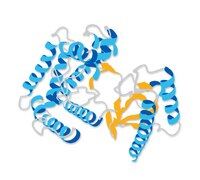
This Protein A, Biotin Conjugate is validated for use in Solid Phase Immunoassay.
More>>This Protein A, Biotin Conjugate is validated for use in Solid Phase Immunoassay. Less<<
Protein A, Biotin Conjugate : FDS (Fiches de données de sécurité), certificats d’analyse (CoA) et de qualité (CoQ), dossiers, brochures et autres documents disponibles.
The protein A: biotin molar ratio is determined on a lot-specific basis. Binding strength is as follows: strongly reactive, guinea pig, human IgG1, IgG2, and IgG4, and rabbit; weakly reactive: bovine, human IgA, IgM, and IgE, and mouse; nonreactive: goat, horse, human IgD and IgG3, rat, and sheep. o-phenylenediamine, 1.0 mg/ml in citrate buffer, pH 4.5, 0.1% urea peroxide at 25°C, was used as substrate for testing biotin-Protein A and avidin peroxidase functionality. Variables associated with assay conditions will dictate the proper working dilution.
Biological Information
Purity
A single band at MW 50,000 by SDS-PAGE
Concentration Label
Please refer to vial label for lot-specific concentration
Physicochemical Information
Dimensions
Materials Information
Toxicological Information
Safety Information according to GHS
Safety Information
Product Usage Statements
Storage and Shipping Information
Ship Code
Ambient Temperature Only
Toxicity
Standard Handling
Storage
-20°C
Avoid freeze/thaw
Avoid freeze/thaw
Do not freeze
Ok to freeze
Special Instructions
Following initial thaw, aliquot and freeze (-20°C).
Note that this data sheet is not lot-specific and is representative of the current specifications for this product. Please consult the vial label and the certificate of analysis for information on specific lots. Also note that shipping conditions may differ from storage conditions.
Revision
27-June-2007 RFH
Application
Solid Phase Immunoassay (1:10,000)
Description
Native protein from Straphylococcus Aureus, conjugated to biotin. Recognizes the Fc portions of immunoglobulins of various species.
Background
Long-chain NHS-Biotin-labeled Protein A is an extremely useful reagent because of its high binding affinity for avidin, streptavidin and avidin- or streptavidin-labeled compounds. Protein A is the universal secondary antibody because it binds to the Fc portions of most immunoglobulin classes. It is a versatile and economic means to isolate, detect and purify antibodies produced by many animals. It is especially useful in immunohistochemical studies because, unlike secondary antibodies, it does not bind to cell Fc receptors, and therefore will not give high background reactions.
Form
Liquid
Formulation
In 10 mM PBS, 1% BSA, pH 7.6.
Concentration Label
Please refer to vial label for lot-specific concentration
Purity
A single band at MW 50,000 by SDS-PAGE
Preservative
≤0.1% sodium azide
Comments
The protein A: biotin molar ratio is determined on a lot-specific basis. Binding strength is as follows: strongly reactive, guinea pig, human IgG1, IgG2, and IgG4, and rabbit; weakly reactive: bovine, human IgA, IgM, and IgE, and mouse; nonreactive: goat, horse, human IgD and IgG3, rat, and sheep. o-phenylenediamine, 1.0 mg/ml in citrate buffer, pH 4.5, 0.1% urea peroxide at 25°C, was used as substrate for testing biotin-Protein A and avidin peroxidase functionality. Variables associated with assay conditions will dictate the proper working dilution.
Storage
Avoid freeze/thaw
-20°C
Do Not Freeze
Ok to freeze
Special Instructions
Following initial thaw, aliquot and freeze (-20°C).